Key takeaways
- AI translation is a great fit for high volume, internal and time-sensitive content.
- Human post-editing turns fast machine output into accurate, publishable text.
- Legal, medical, marketing and brand-critical content still needs full human translation.
- Match the method to the risk: the cost of an error should guide the choice.
AI translation has improved dramatically. For many language pairs it now produces fluent, readable output in seconds. That makes it tempting to use everywhere. But fluent isn't the same as correct, and in business, the difference matters.
Three approaches, three levels of risk
Where each one fits
| Content | Recommended | Why |
|---|---|---|
| Internal emails, research, gist reading | AI only | Speed matters more than polish |
| Knowledge bases, support articles, product catalogues | AI + post-editing | High volume, needs accuracy and consistency |
| User reviews, large data sets | AI + light review | Understanding trends, not publishing |
| Contracts, certificates, compliance documents | Human | Errors carry legal and financial risk |
| Marketing, slogans, brand content | Human / transcreation | Tone and emotion are the point |
What machine translation still gets wrong
- Confident errors: output can sound perfect while reversing a meaning or dropping a negation.
- Terminology drift: the same term translated three different ways in one document.
- Tone and register: too formal, too casual, or inconsistent between paragraphs.
- Gender and agreement: particularly noticeable in Arabic.
- Names and numbers: occasionally altered, reordered or localized incorrectly.
The risk with AI translation isn't that it looks wrong. It's that it looks right.
How post-editing works
- Prepare. We set up your glossary and terminology so the engine starts from the right words.
- Translate. The content runs through a suitable AI engine.
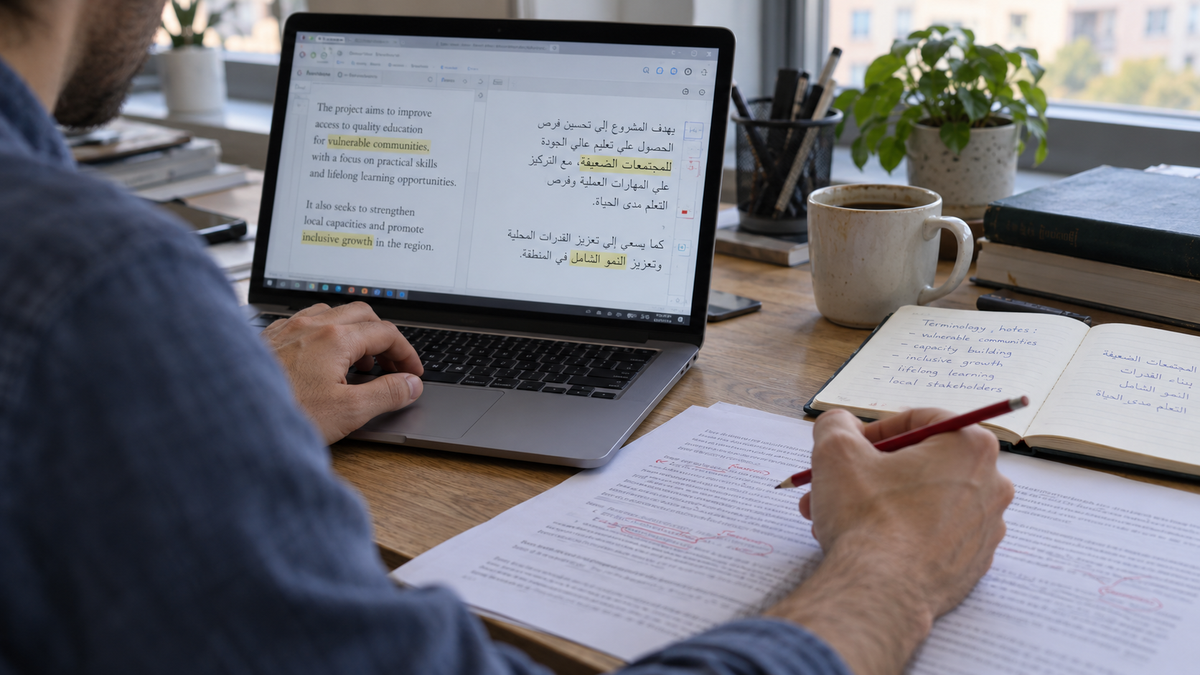
- Post-edit. A professional linguist compares source and output, fixing accuracy, terminology and flow.
- Quality check. Final checks for consistency, numbers and formatting.
Tip: Choose light post-editing when content only needs to be accurate and understandable, and full post-editing when it will be published under your brand.
Privacy check: Don't paste confidential documents into free online translators. Your data may be stored or used for training. Professional workflows use secure, controlled tools.
Quick answers
Is AI + post-editing cheaper than human translation?
Usually, yes, and faster, especially for large volumes of suitable content. We'll tell you honestly if your content isn't a good fit.
Can you post-edit translations we've already run through AI?
Yes. Send both the source and the machine output and we'll review and correct it.
Which languages work best with AI?
Quality varies by language pair and subject. We assess a sample before recommending an approach.
Not sure which approach fits your content?
Send us a sample and we'll recommend the right balance of speed, cost and quality.
Get a QuoteAI Translation & Post-Editing