Key takeaways
- Brand voice is about how you sound, not only what you say, and it needs deliberate translation.
- Transcreation adapts slogans and campaigns so they land emotionally in each market.
- A multilingual tone guide and glossary keep every writer and translator consistent.
- Local review before launch catches cultural misfires early.
A customer in Dubai and a customer in London should both recognise your brand instantly, even if they never read the same sentence. That's the real goal of multilingual marketing: not identical words, but an identical feeling.
Why literal translation flattens a brand
Marketing copy relies on rhythm, wordplay, cultural references and emotion. Translate it literally and you keep the information but lose the personality. A playful English headline can become flat or even awkward in Arabic; a warm, elaborate Arabic message can feel overwritten in English.
Customers don't fall for information. They fall for how a brand makes them feel.
Translation, localization or transcreation?
| Approach | Best for | What changes |
|---|---|---|
| Translation | Product details, terms, specifications | Language only |
| Localization | Websites, brochures, emails | Language, formats, cultural references |
| Transcreation | Slogans, ad campaigns, social content | Wording, imagery and sometimes the concept itself |
Build a multilingual tone guide
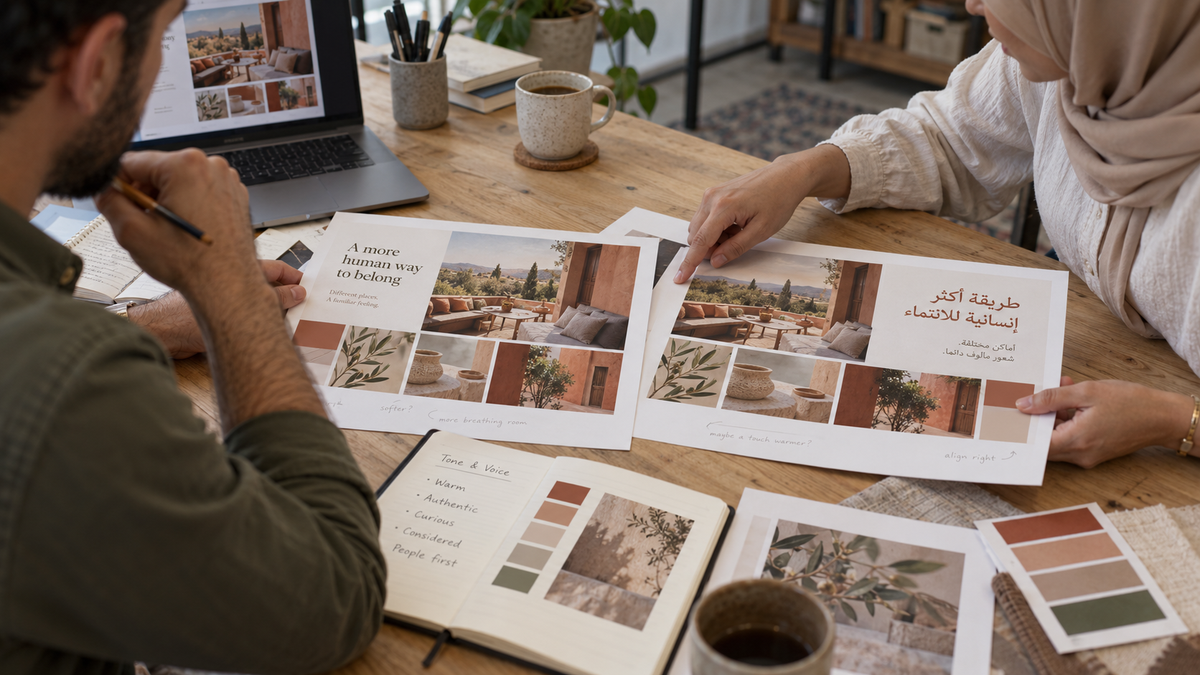
Most brands have a style guide in one language. Extending it to every market you serve is the single most effective step toward consistency. A good guide covers:
Tip: Include "we say / we don't say" examples in both languages. They teach tone faster than any description.
Respect cultural context
Colours, gestures, humour, family imagery and religious or seasonal references all carry different meanings across markets. Campaigns timed around Ramadan, Eid or National Day in the UAE, for example, call for a tone and visual language that a direct adaptation of a Western holiday campaign won't deliver.
Common mistake: Approving translated ads from a spreadsheet. Always review copy in the final design, with the images, because meaning comes from both together.
A review process that protects your brand
- Brief. Share the campaign goal, audience and the feeling you want to create.
- Adapt. A marketing linguist writes, not just translates, the target copy, often with options.
- Back-translate key lines. See what the new headline actually says in English.
- Review in context. Check copy inside the layout, video or landing page.
- Record decisions. Add approved phrases to the glossary for next time.
Quick answers
Can you adapt our slogan for the Arabic market?
Yes. We'll usually present a few options with back-translations and notes, so you can choose with confidence.
Do you handle social media content?
Yes, including captions, hashtags and short-form copy written for each platform's audience.
Can you work with our agency?
Absolutely. We regularly collaborate directly with creative and media agencies.
Launching a campaign in a new language?
Let's make sure it sounds like you, wherever it runs.
Get a QuoteMarketing Translation